JAN3 Releases OMEGA60 Bitcoin Price Model Based on 60% Annual Growth
JAN3’s OMEGA60 uses 60% median annual growth to project Bitcoin above $1 million in 2031, without guaranteeing the outcome.


Bitcoin technology company JAN3 has released OMEGA60, a valuation model that projects Bitcoin’s long-term price using a 60% median annual growth rate.
Introducing the OMEGA60 Bitcoin price model. It’s based on a conservative 60% MAGR and incorporates the Terminus concept, which projects the future point where measuring $BTC in fiat currency terms ceases to make sense.
— Samson Mow (@Excellion) August 18, 2026
OMEGA60 expects Bitcoin at $1.0M in Feb 2031. ♎️📈 https://t.co/qoksJis0DM
The model was originally developed in 2022 to support the design of El Salvador’s proposed Bitcoin bonds.
Its purpose was to estimate the future value of Bitcoin accumulated through the program and compare it with the bonds’ fiat-denominated obligations.
Unlike models that rely on Compound Annual Growth Rates (CAGR), OMEGA60 uses Bitcoin’s Median Annual Growth Rate (MAGR).
JAN3 outlines how the median is less affected by the asset’s extreme market peaks and declines.
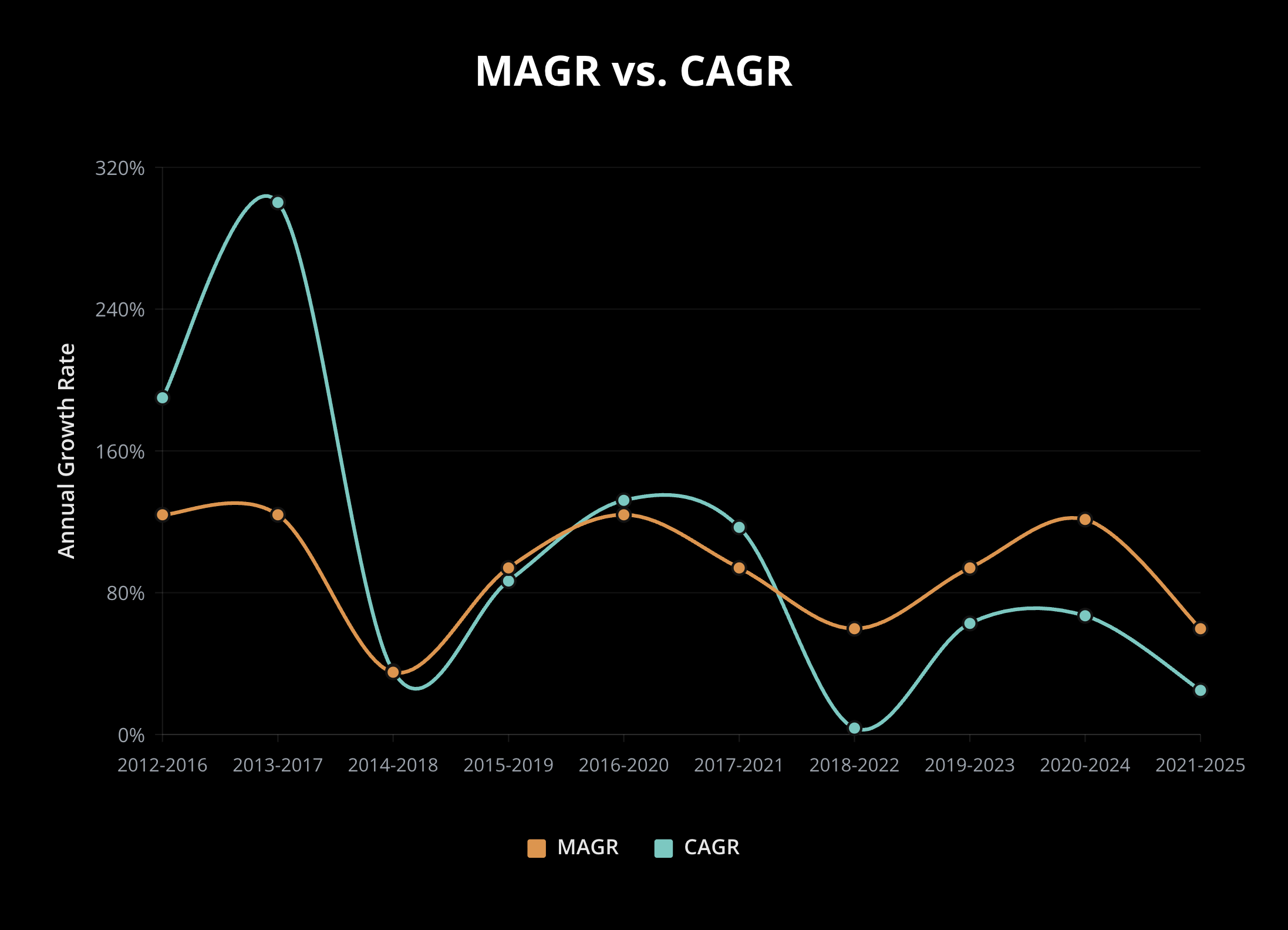
Bitcoin’s annual returns varied from a loss of approximately 73% to a gain of more than 1,300% between 2014 and 2022.
Despite that volatility, the median return for the period was about 59.7%, which JAN3 rounded to 60% for the model.
The company says this approach reduces the influence of the starting and ending dates used in an analysis.
For example, the 2014–2022 and 2018–2022 periods both produced a median annual growth rate of approximately 59.7%, while their compound annual growth rates were about 39.9% and 3.6%, respectively.
OMEGA60 is intended as a long-term trajectory rather than a short-term price target. Bitcoin’s market price can trade substantially above or below the model.
At the time of JAN3’s analysis, Bitcoin was trading near $63,600, compared with an OMEGA60 value of approximately $117,700.
The model projects values of about $181,000 in July 2027, $290,000 in July 2028 and $464,000 in July 2029. Its trajectory crosses $1 million during 2031.
These projections are mathematical results of applying a constant 60% annual growth rate.
JAN3 also compared OMEGA60 with other Bitcoin valuation frameworks.
According to the company, Stock-to-Flow projects a $1 million price in 2028, OMEGA60 in 2031, Michael Saylor’s Bitcoin24 model in 2032, and the Bitcoin power-law model in 2033.
Although the forecasts fall within a relatively narrow period, the models use overlapping historical information and assumptions about continued Bitcoin adoption.
A distinguishing feature of OMEGA60 is what JAN3 calls the “Terminus Line.”
This represents the Bitcoin price at which Bitcoin’s total market capitalization would equal half the estimated value of the global gold market.
Using a gold market capitalization of approximately $31.5 trillion and a Bitcoin supply of about 20.07 million coins, JAN3 calculated a Terminus Line near $785,000 per Bitcoin. OMEGA60 reaches that level in August 2030.
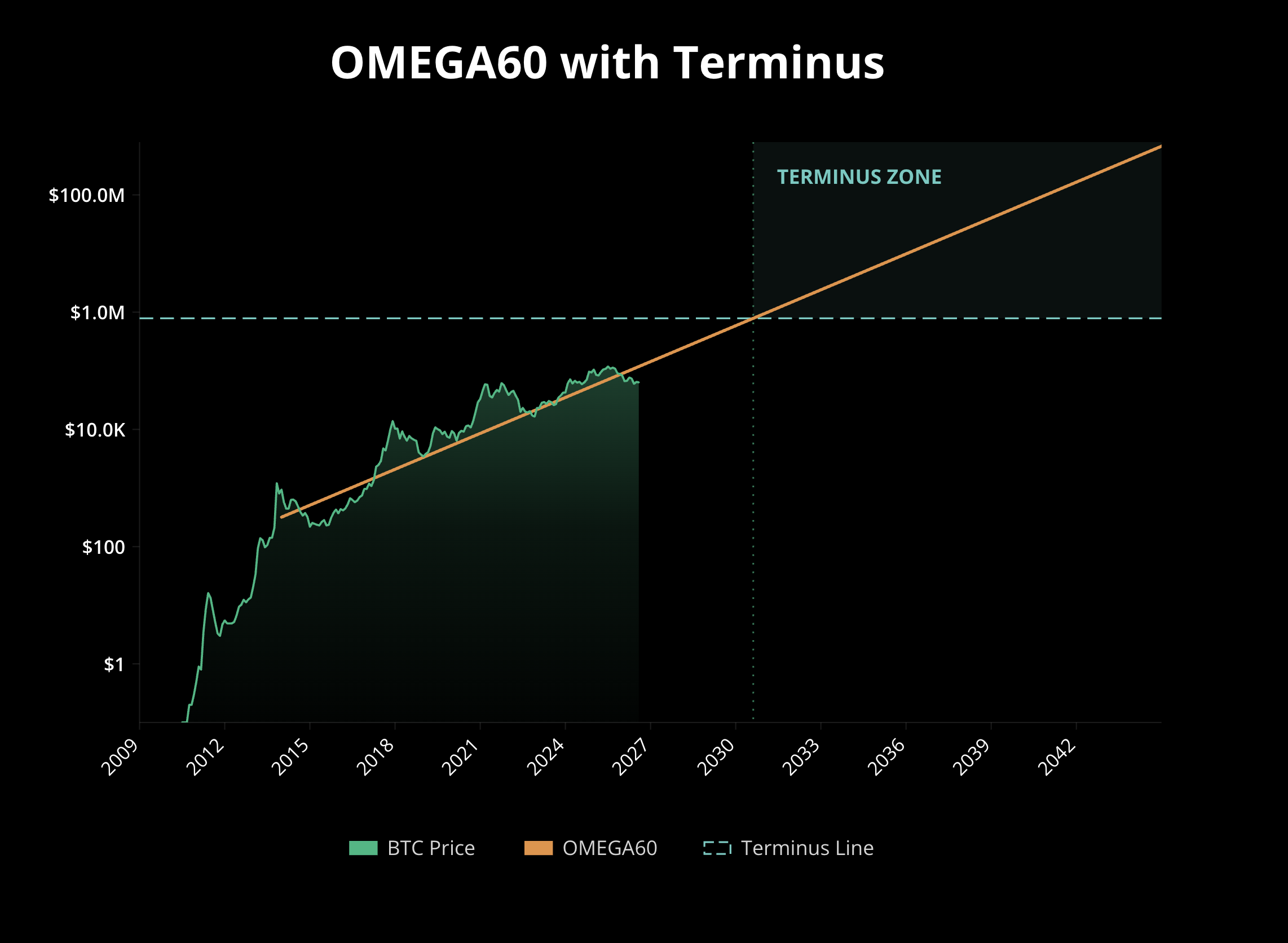
The threshold would change alongside gold’s value and Bitcoin’s circulating supply.
JAN3 presents the view that once Bitcoin approaches the scale of a major monetary asset such as gold, further dollar-price increases could reflect both growing demand and declining fiat purchasing power.
The company calls the period beyond that threshold the “Terminus Zone,” where it believes conventional fiat-based valuation models become less informative.
OMEGA60 is based on Bitcoin’s limited historical record and assumes that its median annual performance can serve as a continuing growth rate. Market conditions could differ significantly in the future.
JAN3 points to Bitcoin’s fixed supply, institutional investment products, corporate and sovereign adoption, global debt, and concerns about fiat currencies as factors that could support demand.
Regulatory changes, liquidity conditions, technological risks and investor behavior could instead cause Bitcoin to depart materially from the projected path.
OMEGA60 is therefore best viewed as a scenario showing what sustained 60% annual growth would imply, rather than a reliable timetable for future prices.