United States Tops JAN3’s 2025 Bitcoin Adoption Ranking
JAN3’s 2025 B20 index ranked the U.S. first for Bitcoin adoption, followed by Bhutan and the U.K.


The United States ranks first in JAN3’s inaugural Bitcoin 20 index, a new assessment of how governments and selected jurisdictions approached Bitcoin adoption in 2025.
Which countries are leading Bitcoin adoption? 🌍
— JAN3 (@JAN3com) July 28, 2026
The Bitcoin 20 (B20) ranks the top nation-states based on holdings, mining, policy, tax treatment, strategic reserves, and real-world use. Explore each country’s profile and score breakdown in the Nation-State Bitcoin Report. 👇 pic.twitter.com/r2py2b7xwH
The U.S. received an adoption score of 7.42 out of 10 and a BBB rating.
Bhutan placed second with 6.64, narrowly ahead of the United Kingdom at 6.44.
El Salvador followed with 5.68, while the United Arab Emirates completed the top five with 4.35.
The ratings resemble the format used by credit-rating agencies, but they measure JAN3’s definition of Bitcoin adoption rather than sovereign creditworthiness.
None of the jurisdictions in the index received an A-range rating.
JAN3, a Bitcoin technology and government advisory company, developed the B20 for its 142-page Nation-State Bitcoin Report 2025.
The company stated that the index draws on government disclosures, legislative records, on-chain information and published research.
The four highest-ranked countries reached their positions through markedly different strategies.
The United States’ result was supported by an estimated 326,588 Bitcoin under government control, primarily obtained through law-enforcement seizures.
However, the report cautions that the figure includes 127,271 Bitcoin involved in a civil forfeiture case for which final ownership had not been determined.
It also identifies discrepancies between estimates of total federal holdings and amounts disclosed by individual agencies.
Bhutan’s position reflects a more deliberate accumulation strategy. The country has used state-backed mining operations powered by hydroelectricity to acquire Bitcoin.
JAN3 estimated that Bhutan held approximately 6,154 Bitcoin at the end of 2025, after previously controlling more than 13,000 Bitcoin and selling part of its position to fund public programs.
The United Kingdom’s estimated 61,000 Bitcoin also came mainly from criminal seizures.
The report notes that legal claims by victims could limit how much of that amount is ultimately available to the government.
El Salvador, meanwhile, earned points for its 2021 Bitcoin legislation, public accumulation program and payment infrastructure.
JAN3 estimated its holdings at 7,509 Bitcoin and cited the country’s policy of purchasing one Bitcoin per day, introduced in 2022.
China illustrates why government holdings alone did not determine the ranking.
Despite an estimated 194,000 Bitcoin connected largely to the PlusToken case, China placed sixth.
The report said the status of those assets remains uncertain and weighed the country’s restrictive policy environment against the size of its holdings.
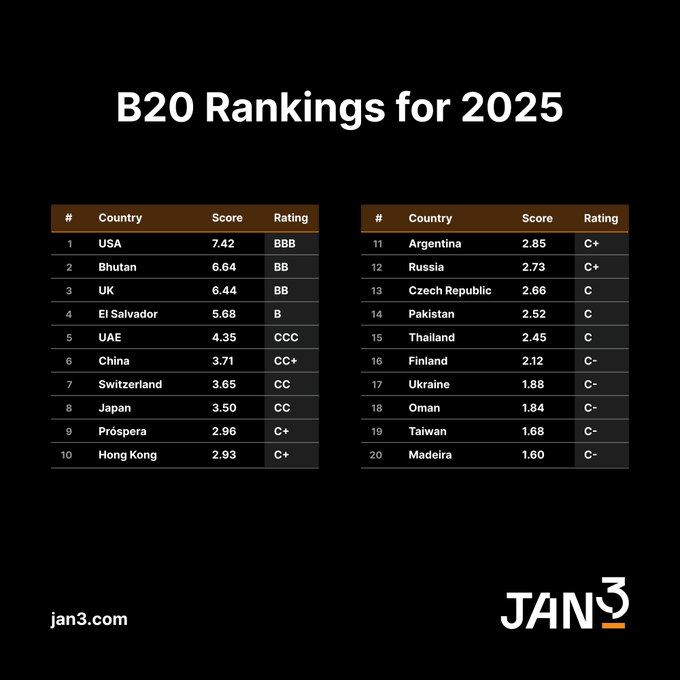
Although JAN3 describes the B20 as a nation-state ranking, the index also covers territories and special jurisdictions, including Hong Kong, Madeira, and Próspera.
Quantitative indicators account for 60% of each base score. Bitcoin holdings relative to gross domestic product carry the greatest weight at 30%.
Holdings per person, state mining capacity, and long-term government debt used to finance Bitcoin operations each contribute 10%.
The remaining 40% comes from qualitative assessments. The degree to which Bitcoin is incorporated into a jurisdiction’s financial and commercial system accounts for 20%, while sovereign reserve policies contribute 10%.
Government initiatives and capital-gains tax treatment each represent another 5%.
JAN3 then applies an adjustment based on gross domestic product at purchasing-power parity.
The company argues that Bitcoin-related decisions by larger economies can have greater international consequences.
The resulting index provides a broad comparison of government policies, public holdings and economic activity, but it is not an official or independently administered benchmark.
Qualitative judgments, the economic-size adjustment and uncertainty surrounding seized assets can all influence the final order.
The rankings therefore represent JAN3’s assessment of conditions in 2025 rather than a definitive measure of adoption.